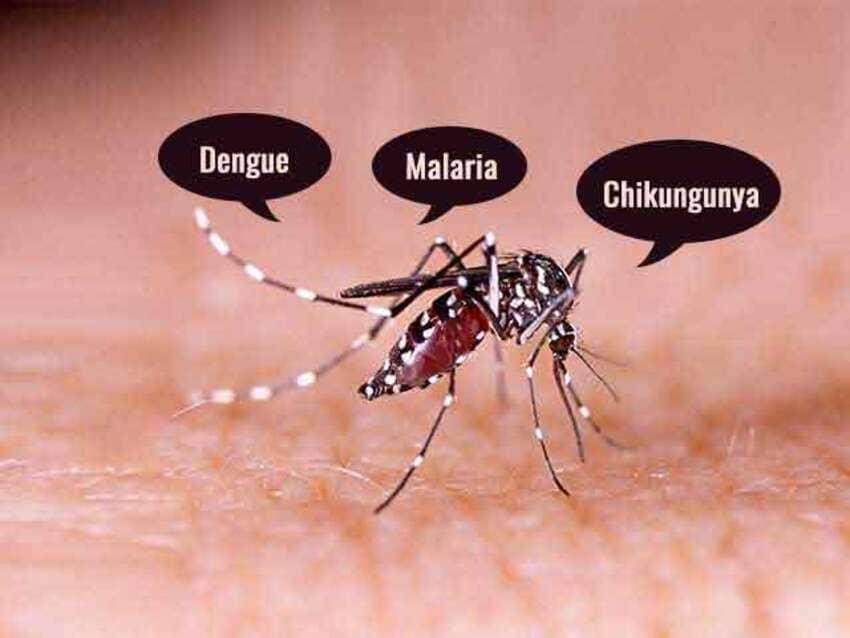
Climate-Driven Transmission Dynamics of Dengue and Malaria: A Compartmental Modelling Framework Incorporating Temperature, Rainfall, and Humidity
Title
Climate-Driven Transmission Dynamics of Dengue and Malaria: A Compartmental Modelling Framework Incorporating Temperature, Rainfall, and Humidity
Author
1. Yogita Sudhakar Naik, Professor, Ghanshyamdas Saraf College of Arts and Commerce, India
Abstract
Climate change is altering the epidemiological landscape of vector-borne diseases, with dengue fever and malaria presenting particular challenges for public health systems in tropical and subtropical regions. This study develops and analyses a climate-sensitive compartmental model based on a system of ordinary differential equations (ODEs) that incorporates temperature, rainfall, and humidity as dynamic inputs governing mosquito population biology and disease transmission. The basic reproduction number (R₀) is derived analytically, and local stability conditions for both the disease-free equilibrium (DFE) and the endemic equilibrium (EE) are established. Numerical simulations conducted over a three-year horizon under baseline and perturbed climate scenarios reveal that temperature is the dominant driver of outbreak intensity (PRCC = 0.75), with a +2°C anomaly sufficient to push R₀ above unity and elevate outbreak probability beyond 80% in high-density urban settings. Dengue transmission peaks at 37.5°C with 120–140 mm monthly rainfall, while malaria transmission is optimal at 25°C with relative humidity exceeding 70%. These findings quantify critical climatic thresholds and underscore the need to integrate climate projections into epidemiological early-warning systems and adaptive public health policy.
Keywords
Conclusion
This study has developed an analytically tractable, climate-sensitive SEIR-V compartmental model for dengue fever and malaria, incorporating temperature-, rainfall-, and humidity-dependent mosquito population functions derived from empirical thermal performance curves. The basic reproduction number R₀ was derived analytically using the next-generation matrix method, and local stability of the disease-free and endemic equilibria was established. Numerical simulations and PRCC-based sensitivity analysis quantified the relative contributions of climatic drivers to outbreak intensity and identified critical thresholds—notably a +2°C temperature anomaly and 80% relative humidity—beyond which epidemic potential increases nonlinearly.
Temperature emerged as the dominant climatic driver (PRCC = 0.75), followed by rainfall and humidity, with disease-specific thermal optima consistent with established empirical findings. The model also captured the temporal offset between dengue and malaria seasonal peaks in South Asian settings, providing a basis for coordinated surveillance and resource planning.
Future work should extend the model to include spatial heterogeneity through patch or partial differential equation formulations, incorporate age-structured human populations, and validate against multi-year surveillance data from high-burden districts in India. Coupling the model with regional climate model outputs under IPCC SSP scenarios would enable quantitative projections of long-term disease burden under alternative emission pathways.
Author Contrubution
The author confirms sole responsibility for all stages of the study, including design, data collection, analysis, and manuscript writing.
Funding
This study did not receive specific financial support from funding agencies in the public, commercial, or non-profit sectors.
Conflict of Interest
The authors have no conflicts of interest to declare.
Data Sharing Statement
Not applicable
Software And Tools Use
Not applicable
Acknowledgements
I appreciate the assistance and expertise provided by everyone involved in this research and manuscript, and the valuable comments from peer reviewers.
Corresponding Author
Yogita Sudhakar Naik
Ghanshyamdas Saraf College of Arts and Commerce, Professor, India
Copyright
Copyright: ©2026 Corresponding Author. This is an open access article distributed under the terms of the Creative Commons Attribution License , which permits unrestricted use, distribution, and reproduction in any medium, provided the original author and source are credited.
Naik, Yogita Sudhakar. “Climate-Driven Transmission Dynamics of Dengue and Malaria: A Compartmental Modelling Framework Incorporating Temperature, Rainfall, and Humidity.” Scientific Research Journal of Science, Engineering and Technology, vol. 4, no. 1, 2026, pp. 155-165, https://isrdo.org/journal/SRJSET/currentissue/climate-driven-transmission-dynamics-of-dengue-and-malaria-a-compartmental-modelling-framework-incorporating-temperature-rainfall-and-humidity
Naik, Y. (2026). Climate-Driven Transmission Dynamics of Dengue and Malaria: A Compartmental Modelling Framework Incorporating Temperature, Rainfall, and Humidity. Scientific Research Journal of Science, Engineering and Technology, 4(1), 155-165. https://isrdo.org/journal/SRJSET/currentissue/climate-driven-transmission-dynamics-of-dengue-and-malaria-a-compartmental-modelling-framework-incorporating-temperature-rainfall-and-humidity
Naik Yogita Sudhakar, Climate-Driven Transmission Dynamics of Dengue and Malaria: A Compartmental Modelling Framework Incorporating Temperature, Rainfall, and Humidity, Scientific Research Journal of Science, Engineering and Technology 4, no. 1(2026): 155-165, https://isrdo.org/journal/SRJSET/currentissue/climate-driven-transmission-dynamics-of-dengue-and-malaria-a-compartmental-modelling-framework-incorporating-temperature-rainfall-and-humidity
3775
Total words1622
Unique Words136
Sentence25.911764705882
Avg Sentence Length0.19853861885663
Subjectivity0.044826038085689
PolarityText Statistics
Viewed / Downloads
Total article views: 196 (including HTML, PDF, and XML)| HTML | XML | Total | |
|---|---|---|---|
| 129 | 47 | 20 | 196 |
Viewed (geographical distribution)
Thereof 196 with geography defined and 0 with unknown origin.