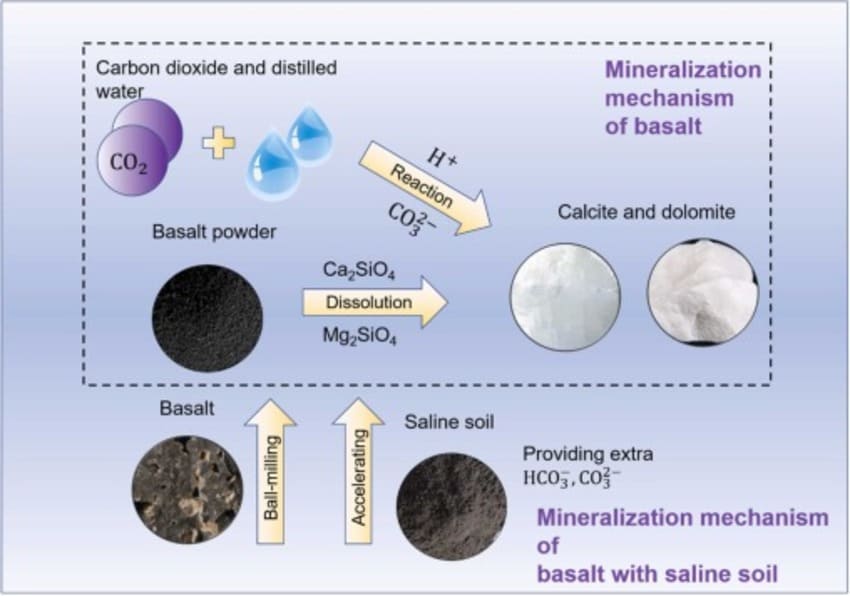
Advances in Basalt-Driven CO₂ Mineralization: Reactivity, Mechanisms, Kinetics, and Reservoir-Scale Prospects for Permanent Carbon Storage
Title
Advances in Basalt-Driven CO₂ Mineralization: Reactivity, Mechanisms, Kinetics, and Reservoir-Scale Prospects for Permanent Carbon Storage
Author
1. Belinda Ahordo,
Student, University of Mines and Technology, Ghana
2. Victoria Sanja,
Professor, University of Mines and Technology, Ghana
Abstract
Basalt-rich geological formations have emerged as one of the most promising natural systems for permanent CO₂ sequestration due to their high reactivity with injected carbon dioxide and their ability to form stable carbonate minerals. Recent research has significantly advanced the understanding of basalt–CO₂ interactions, covering mineral dissolution kinetics, aqueous and gas–solid phase pathways, reactive transport behavior, and the impact of fracture networks on mineralization efficiency. Studies have highlighted the role of basaltic minerals—especially olivine, pyroxene, and plagioclase—in accelerating carbonation reactions and enhancing long-term storage security. Mechanistic investigations have provided molecular-scale insights into surface reactions, revealing that basalt–CO₂ interactions proceed through coupled dissolution–precipitation pathways governed by temperature, fluid composition, and mineral structure. Process-controlled mineralization shows that manipulating flow regimes, pH, and reactive surface area can significantly boost carbonation rates and tune reservoir properties for optimal storage. Studies exploring low-kinetic gas–solid to aqueous transitions further demonstrate new technological routes for CCS using basalt under varied environmental conditions. Large-scale modeling efforts provide a systems view of mineral trapping and estimate long-term storage potential under realistic field conditions. Collectively, these studies outline a maturing scientific and technological framework for CO₂ mineralization in basalt and position basaltic systems as viable, scalable solutions for global decarbonization efforts.
Keywords
Conclusion
The collective findings across these studies provide compelling evidence that basalt formations are among the most effective geological media for permanent CO₂ sequestration. Basalt’s mineral composition, porosity, and global abundance make it uniquely suited for rapid mineralization processes that securely lock carbon in stable solid phases. Surface reaction studies reveal that carbonation proceeds through well-defined dissolution–precipitation mechanisms influenced by mineral structure and fluid chemistry. Engineering advancements now allow substantial acceleration of mineralization through controlled manipulation of temperature, injection regimes, and reactive transport behavior.
Low-kinetic pathway studies expand the applicability of basalt mineralization into new environmental contexts, demonstrating potential even in shallow or low-temperature formations. Field-scale modeling confirms that basaltic reservoirs can safely store large volumes of injected CO₂ with minimal long-term risk. As global decarbonization efforts intensify, basalt-based CO₂ mineralization stands out as a robust, scalable, and permanent solution that complements renewable energy, carbon capture technology, and climate mitigation strategies. The integrated insights from the referenced studies underscore the readiness and potential of basalt mineralization to play a major role in climate stabilization efforts worldwide.
Author Contrubution
The author takes full responsibility for the entire study process, including design, data collection, analysis, and manuscript writing.
Funding
The research, authorship, and publication of this article were not funded by any specific grants from public, commercial, or non-profit agencies.
Conflict of Interest
No conflicts of interest are reported by the authors.
Data Sharing Statement
Not applicable.
Software And Tools Use
Not applicable.
Acknowledgements
I extend my gratitude to everyone who contributed their expertise to this study and manuscript, and to the anonymous reviewers for their helpful comments.
Corresponding Author
Belinda Ahordo
University of Mines and Technology, Student, Ghana
Victoria Sanja
University of Mines and Technology, Professor, Ghana
Copyright
Copyright: ©2026 Corresponding Author. This is an open access article distributed under the terms of the Creative Commons Attribution License , which permits unrestricted use, distribution, and reproduction in any medium, provided the original author and source are credited.
Ahordo, Belinda, and Sanja, Victoria. “Advances in Basalt-Driven CO₂ Mineralization: Reactivity, Mechanisms, Kinetics, and Reservoir-Scale Prospects for Permanent Carbon Storage.” Scientific Research Journal of Environment, Earth and Physical Science, vol. 3, no. 2, 2026, pp. 24-31, https://isrdo.org/journal/SRJEEP/currentissue/advances-in-basalt-driven-co2-mineralization-reactivity-mechanisms-kinetics-and-reservoir-scale-prospects-for-permanent-carbon-storage
Ahordo, B., & Sanja, V. (2026). Advances in Basalt-Driven CO₂ Mineralization: Reactivity, Mechanisms, Kinetics, and Reservoir-Scale Prospects for Permanent Carbon Storage. Scientific Research Journal of Environment, Earth and Physical Science, 3(2), 24-31. https://isrdo.org/journal/SRJEEP/currentissue/advances-in-basalt-driven-co2-mineralization-reactivity-mechanisms-kinetics-and-reservoir-scale-prospects-for-permanent-carbon-storage
Ahordo Belinda and Sanja Victoria, Advances in Basalt-Driven CO₂ Mineralization: Reactivity, Mechanisms, Kinetics, and Reservoir-Scale Prospects for Permanent Carbon Storage, Scientific Research Journal of Environment, Earth and Physical Science 3, no. 2(2026): 24-31, https://isrdo.org/journal/SRJEEP/currentissue/advances-in-basalt-driven-co2-mineralization-reactivity-mechanisms-kinetics-and-reservoir-scale-prospects-for-permanent-carbon-storage
2978
Total words1187
Unique Words133
Sentence21.977443609023
Avg Sentence Length0.28837817161953
Subjectivity0.071983118510562
PolarityText Statistics
Viewed / Downloads
Total article views: 210 (including HTML, PDF, and XML)| HTML | XML | Total | |
|---|---|---|---|
| 127 | 56 | 27 | 210 |
Viewed (geographical distribution)
Thereof 210 with geography defined and 0 with unknown origin.