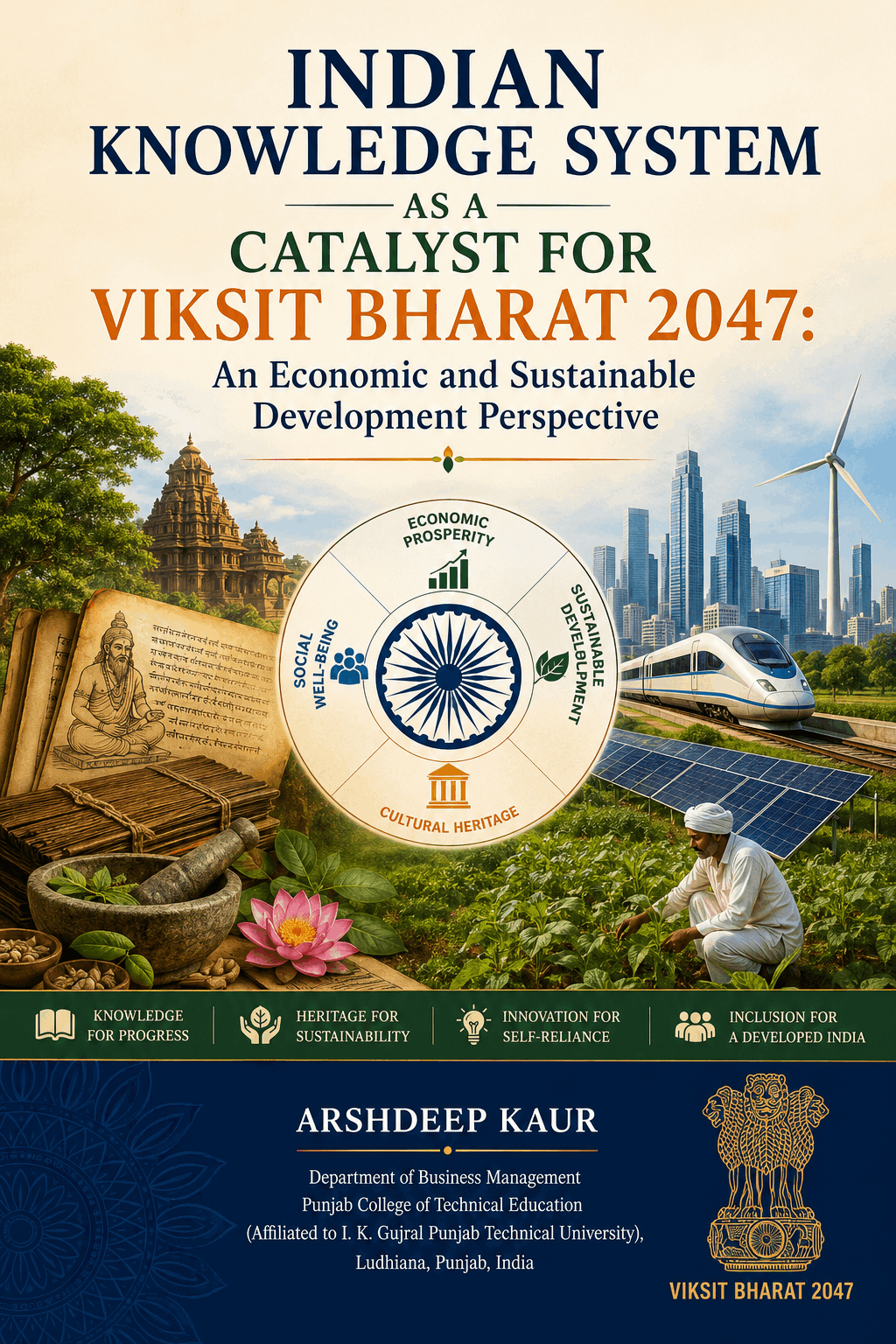
Indian Knowledge System as a Catalyst for Viksit Bharat 2047: An Economic and Sustainable Development Perspective
Title
Indian Knowledge System as a Catalyst for Viksit Bharat 2047: An Economic and Sustainable Development Perspective
Author
1. Arshdeep kaur, Assistant Professor, Punjab College of Technical Education, India
Abstract
The Indian Knowledge System (IKS) represents a vast and living body of traditional wisdom that spans education, philosophy, medicine, agriculture, governance, architecture, and environmental stewardship. As India works toward the vision of Viksit Bharat 2047 — a developed, self-reliant, and globally competitive nation by the centenary of its independence — there is growing recognition that this indigenous knowledge base can meaningfully complement modern development strategy rather than sit apart from it. This chapter examines how IKS can serve as a catalyst for Viksit Bharat 2047 from an economic and sustainable development standpoint. Using a qualitative, secondary-data-based research design, the study draws on peer-reviewed literature, government policy documents, and institutional reports to examine how indigenous knowledge intersects with education, agriculture, healthcare, rural entrepreneurship, and environmental management. It also considers key policy instruments, including the National Education Policy (NEP) 2020, the Indian Knowledge Systems Division, Startup India, Digital India, and the PM Vishwakarma Scheme, as institutional bridges between traditional wisdom and contemporary governance. The analysis suggests that combining IKS with modern science and technology can generate employment, strengthen sustainable resource management, and reinforce cultural identity, while also identifying documentation gaps, weak scientific validation, and fragmented policy implementation as persistent barriers. The chapter concludes that a deliberate, coordinated integration of indigenous knowledge into education, entrepreneurship, and public policy is central to realising a development model that is economically sound, ecologically responsible, and culturally rooted.
Keywords
Conclusion
This chapter has examined the Indian Knowledge System as a potential catalyst for the Viksit Bharat 2047 vision, focusing specifically on its economic and sustainable development dimensions. The evidence reviewed suggests that IKS offers a genuinely distinctive development resource — one that pairs economic activity with environmental responsibility, social equity, and cultural continuity, rather than treating these as competing priorities — and that this orientation is already partially reflected in national programmes such as NEP 2020, Atmanirbhar Bharat, and the PM Vishwakarma Scheme. At the same time, the analysis points clearly to unfinished work: much indigenous knowledge remains undocumented and scientifically unvalidated, institutional support is uneven across sectors, and intellectual property protections have not kept pace with the commercial potential of traditional knowledge. Realising IKS's contribution to Viksit Bharat 2047 will depend less on further reaffirming its relevance — which the literature now does fairly consistently — and more on the harder, less visible work of documentation, validation, faculty capacity-building, and coordinated policy implementation across government, academia, industry, and local communities. Approached this way, India's traditional knowledge heritage is not simply a cultural inheritance to be preserved, but a strategic resource that, if systematically integrated with modern science and public policy, can meaningfully support a development path that is economically competitive, environmentally sustainable, and culturally rooted.
Author Contrubution
6
Funding
This research received no specific grant from any funding agency in the public, commercial, or not-for-profit sectors. The study was conducted independently by the author as part of academic research.
Conflict of Interest
There is no conflict of interest regarding the publication of this book chapter. The research was conducted independently using secondary data from publicly available academic literature, government reports, and institutional publications. No financial, commercial, or personal relationships influenced the study's design, analysis, interpretation, or conclusions.
Data Sharing Statement
The study is based exclusively on secondary data obtained from publicly accessible academic publications, government reports, and policy documents. As no original datasets were generated or analyzed, no additional data are available.
Software And Tools Use
Acknowledgements
I expresses sincere gratitude to the Department of Business Management, Punjab College of Technical Education (Affiliated to I. K. Gujral Punjab Technical University), for providing a supportive academic environment that facilitated the completion of this book chapter. I also acknowledges the valuable contributions of researchers, scholars, government agencies, and institutions whose published works, policy documents, and reports have served as important sources of information for this study. Their contributions have significantly enriched the understanding of the Indian Knowledge System and its role in promoting sustainable economic development and the vision of Viksit Bharat 2047.
Corresponding Author
Arshdeep kaur
Punjab College of Technical Education, Assistant Professor, India
Copyright
Copyright: ©2026 Corresponding Author. This is an open access article distributed under the terms of the Creative Commons Attribution License , which permits unrestricted use, distribution, and reproduction in any medium, provided the original author and source are credited.
kaur, Arshdeep. “Indian Knowledge System as a Catalyst for Viksit Bharat 2047: An Economic and Sustainable Development Perspective.” Scientific Research Journal of Business, Management and Accounting, vol. 4, no. 1, 2026, pp. 33-40, https://isrdo.org/journal/SRJBMA/currentissue/indian-knowledge-system-as-a-catalyst-for-viksit-bharat-2047-an-economic-and-sustainable-development-perspective
kaur, A. (2026). Indian Knowledge System as a Catalyst for Viksit Bharat 2047: An Economic and Sustainable Development Perspective. Scientific Research Journal of Business, Management and Accounting, 4(1), 33-40. https://isrdo.org/journal/SRJBMA/currentissue/indian-knowledge-system-as-a-catalyst-for-viksit-bharat-2047-an-economic-and-sustainable-development-perspective
kaur Arshdeep, Indian Knowledge System as a Catalyst for Viksit Bharat 2047: An Economic and Sustainable Development Perspective, Scientific Research Journal of Business, Management and Accounting 4, no. 1(2026): 33-40, https://isrdo.org/journal/SRJBMA/currentissue/indian-knowledge-system-as-a-catalyst-for-viksit-bharat-2047-an-economic-and-sustainable-development-perspective
4087
Total words1416
Unique Words130
Sentence30.6
Avg Sentence Length0.27307936507937
Subjectivity0.078955128205128
PolarityText Statistics
Viewed / Downloads
Total article views: 19 (including HTML, PDF, and XML)| HTML | XML | Total | |
|---|---|---|---|
| 10 | 3 | 6 | 19 |
Viewed (geographical distribution)
Thereof 19 with geography defined and 0 with unknown origin.