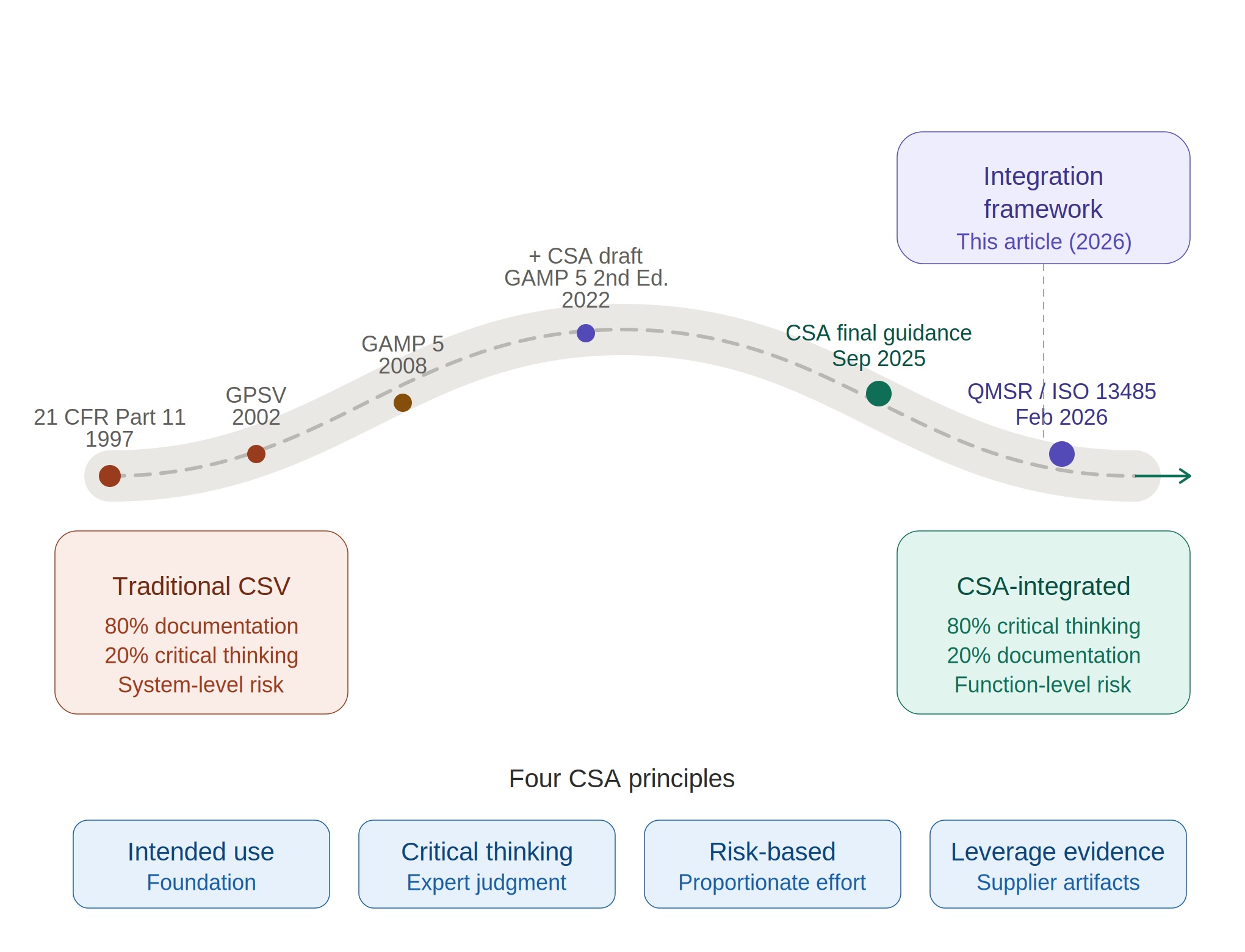
Integrating Computer Software Assurance into Existing Computer System Validation Programs: A Practical Risk-Based Framework
Title
Integrating Computer Software Assurance into Existing Computer System Validation Programs: A Practical Risk-Based Framework
Author
1. Birju Patel,
Director, Anika Therapeutics, United States
2. Jayminkumar Patel,
Developer, Amneal Pharmaceuticals, United States
Abstract
Background: The U.S. Food and Drug Administration (FDA) finalized
its Computer Software Assurance (CSA) guidance in September 2025, signaling a
paradigm shift from documentation-centric Computer System Validation (CSV)
approaches toward risk-based, critical thinking-driven practices for production
and quality system software in regulated life sciences industries. While the
CSA framework offers significant benefits, including resource optimization and
faster implementation cycles, many organizations struggle with practical
integration into established CSV programs.
Methods: This article employs a structured analytical framework
combining regulatory document analysis, industry literature review, and
synthesis of implementation experience in pharmaceutical and medical device
manufacturing environments. The integration methodology was developed by
mapping CSA principles against established CSV lifecycle activities and
identifying specific modification points within existing validation workflows.
Results: A phased integration strategy was developed, encompassing
assessment, planning, and implementation stages. Key integration points include
modifications to Computer System Risk Assessment (CSRA) procedures
incorporating intended use analysis, requirement-level risk evaluations aligned
with the CSA risk framework differentiating Critical Attributes from Business
or Engineering Attributes, and differentiated testing strategies proportionate
to risk. The framework demonstrates potential for 30-50% reduction in total
validation effort for low and medium-risk systems while maintaining or
enhancing rigor for high-risk functionality.
Conclusion: CSA implementation represents an evolution rather than
a revolution of CSV practices. The integration framework presented enables
organizations to adopt CSA principles systematically while maintaining
regulatory compliance, achieving improved resource allocation, enhanced focus
on critical functionality, and better alignment with modern software
development methodologies. Successful implementation requires investment in
critical thinking capability, structured change management, and robust
documentation of risk-based rationale.
Keywords
Conclusion
Computer
Software Assurance represents an evolution, not a revolution, in validation
practices for pharmaceutical and medical device manufacturers. The FDA’s
finalization of the CSA guidance in September 2025, aligned with GAMP 5 Second
Edition principles and supported by the ongoing harmonization of 21 CFR Part
820 with ISO 13485:2016, provides regulatory clarity and industry best
practices for risk-based validation approaches that maintain patient safety and
product quality while optimizing resource allocation and enabling adoption of
modern technologies.
Successful
CSA integration into existing CSV programs requires structured implementation
addressing risk assessment methodology, testing strategy evolution,
documentation optimization, and organizational change management. The phased
approach presented in this article, encompassing assessment, planning, and
implementation with specific enhancements to CSRA and requirement risk
assessment processes, provides a practical framework that regulated
organizations can adapt to their specific contexts.
Key
integration points include enhanced computer system risk assessment
incorporating intended use analysis and CSA risk factors, function-level
requirement risk assessment driving differentiated testing strategies,
appropriate leveraging of supplier documentation and testing evidence, and
fit-for-purpose documentation practices. These modifications enable meaningful
resource optimization for low and medium-risk systems, with practitioner
reports describing improvements that range widely depending on baseline
maturity and scope, while maintaining or enhancing focus on critical
functionality affecting product quality and patient safety.
Implementation
challenges, including cultural resistance, critical thinking skill development,
and regulatory acceptance concerns, can be successfully mitigated through
comprehensive training, pilot program approaches, clear documentation of
rationale, and a continuous improvement mindset. Organizations that invest in
building critical thinking capability and embed risk-based principles into
quality system culture realize substantial benefits including faster
implementation cycles, reduced technical debt, better alignment with modern
software development practices, and enhanced regulatory posture.
As the life sciences industry continues evolving toward digital transformation, cloud computing, artificial intelligence and machine learning applications, and real-time manufacturing analytics, CSA principles provide the regulatory framework and practical methodology for validating these advanced technologies efficiently while ensuring product quality and patient safety remain paramount. The concurrent harmonization of the Quality System Regulation with ISO 13485:2016, effective February 2, 2026, further reinforces the global trajectory toward risk-based, outcomes-focused quality assurance approaches. Organizations that successfully integrate CSA into their validation programs position themselves for competitive advantage through accelerated innovation adoption, optimized resource utilization, and enhanced quality focus.
Author Contrubution
B.P. and J.P. contributed to the design and implementation of the research, to the analysis of the results and to the writing of the manuscript.
Funding
This research received no external funding.
Conflict of Interest
The authors declare that the research was conducted in the absence of any commercial or financial relationships that could be construed as a potential conflict of interest. The views and opinions expressed in this article are those of the authors and do not necessarily reflect the official positions of their respective employers.
Data Sharing Statement
No new data were generated or analyzed in this study. All regulatory documents and industry guidance referenced are publicly available through the sources cited in the reference list.
Software And Tools Use
Acknowledgements
The authors acknowledge the contributions of validation professionals, quality assurance personnel, and system subject matter experts whose practical experience informed the integration approaches described in this article.
Corresponding Author
Birju Patel
Anika Therapeutics, Director, United States
Jayminkumar Patel
Amneal Pharmaceuticals, Developer, United States
Copyright
Copyright: ©2026 Corresponding Author. This is an open access article distributed under the terms of the Creative Commons Attribution License , which permits unrestricted use, distribution, and reproduction in any medium, provided the original author and source are credited.
Patel, Birju, and Patel, Jayminkumar. “Integrating Computer Software Assurance into Existing Computer System Validation Programs: A Practical Risk-Based Framework.” Scientific Research Journal of Science, Engineering and Technology, vol. 4, no. 1, 2026, pp. 72-85, https://isrdo.org/journal/SRJSET/currentissue/integrating-computer-software-assurance-into-existing-computer-system-validation-programs-a-practical-risk-based-framework
Patel, B., & Patel, J. (2026). Integrating Computer Software Assurance into Existing Computer System Validation Programs: A Practical Risk-Based Framework. Scientific Research Journal of Science, Engineering and Technology, 4(1), 72-85. https://isrdo.org/journal/SRJSET/currentissue/integrating-computer-software-assurance-into-existing-computer-system-validation-programs-a-practical-risk-based-framework
Patel Birju and Patel Jayminkumar, Integrating Computer Software Assurance into Existing Computer System Validation Programs: A Practical Risk-Based Framework, Scientific Research Journal of Science, Engineering and Technology 4, no. 1(2026): 72-85, https://isrdo.org/journal/SRJSET/currentissue/integrating-computer-software-assurance-into-existing-computer-system-validation-programs-a-practical-risk-based-framework
7037
Total words2055
Unique Words253
Sentence27.359683794466
Avg Sentence Length0.30939140958953
Subjectivity0.048075427756258
PolarityText Statistics
Viewed / Downloads
Total article views: 338 (including HTML, PDF, and XML)| HTML | XML | Total | |
|---|---|---|---|
| 164 | 133 | 41 | 338 |
Viewed (geographical distribution)
Thereof 338 with geography defined and 0 with unknown origin.