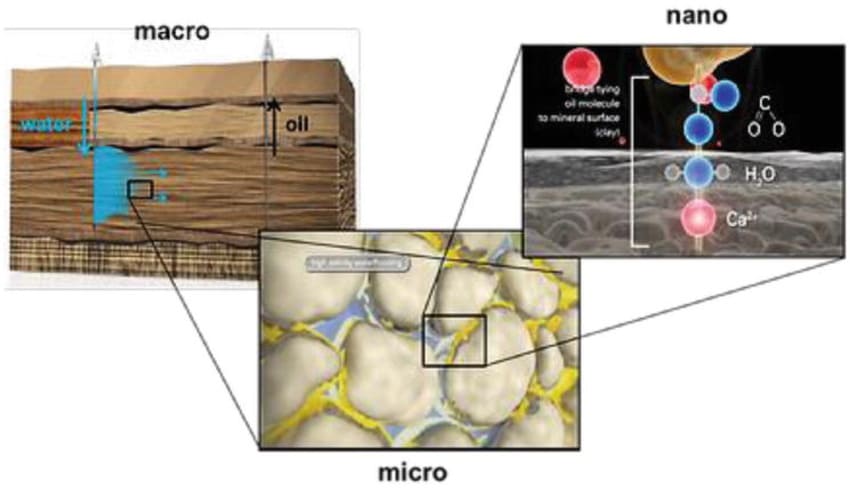
Advances, Mechanisms, and Hybrid Strategies in Low-Salinity and Smart Water Enhanced Oil Recovery: A Comprehensive Review
Title
Advances, Mechanisms, and Hybrid Strategies in Low-Salinity and Smart Water Enhanced Oil Recovery: A Comprehensive Review
Author
1. Hanadi Shahin,
Student, University of Zakho, Iraq
2. Jafar Ali,
Professor, University of Zakho, Iraq
Abstract
Low-salinity waterflooding (LSW) and smart water injection have emerged as leading techniques in Enhanced Oil Recovery (EOR), with significant potential to optimize oil production from sandstone and carbonate reservoirs. Over the past decade, advancements in the understanding of ion exchange, wettability modification, multi-ion interactions, and hybridization with chemical EOR methods have shifted LSW from a laboratory observation to a field-validated recovery strategy. This review integrates current progress in low-salinity, smart water, and hybrid LSW-chemical methods, highlighting breakthrough findings on nanoparticle synergy, polymer interactions, wettability alteration, pH effects, salinity thresholds, and reservoir mineralogical compatibility. Detailed evaluations of experimental, numerical, and pilot-scale field studies are presented, offering a structured perspective on the mechanisms and practical conditions that govern LSW success. Emerging hybrid methods combining surfactants, alkali, nanoparticles, and polymers with LSW demonstrate measurable improvements in sweep efficiency, mobility control, interfacial tension (IFT) reduction, and tertiary recovery potential. Overall, this review provides an extensive synthesis of current trends, implementation challenges, and research opportunities for future EOR operations.
Keywords
Conclusion
Low-salinity and smart waterflooding have transitioned from laboratory concepts to field-validated EOR strategies, supported by strong mechanistic understanding and promising field results. The technology's adaptability across sandstone and carbonate reservoirs, combined with rapid advancements in smart water formulation, makes LSW one of the most dynamic areas in modern petroleum engineering. Hybridization with chemical and nanomaterial-based EOR techniques further amplifies recovery potential, addressing limitations related to sweep efficiency, mobility, and IFT reduction. Numerical and pilot-study evidence underscores its practical viability, while ongoing innovation continues to refine and expand its application. Overall, LSW stands as a robust, cost-effective, and environmentally favorable technique poised to play a significant role in future oil recovery operations.
Author Contrubution
The author alone is responsible for the study's conception, design, data collection, analysis, interpretation, and manuscript preparation.
Funding
No specific grants from any funding agencies in the public, commercial, or non-profit sectors were received for this research, authorship, or publication.
Conflict of Interest
The authors declare no conflicts of interest related to this study.
Data Sharing Statement
Not applicable.
Software And Tools Use
Not applicable.
Acknowledgements
I express my gratitude to those who provided expertise and assistance throughout this study and manuscript preparation. Special thanks to the anonymous peer reviewers for their valuable feedback.
Corresponding Author
Hanadi Shahin
University of Zakho, Student, Iraq
Jafar Ali
University of Zakho, Professor, Iraq
Copyright
Copyright: ©2026 Corresponding Author. This is an open access article distributed under the terms of the Creative Commons Attribution License , which permits unrestricted use, distribution, and reproduction in any medium, provided the original author and source are credited.
Shahin, Hanadi, and Ali, Jafar. “Advances, Mechanisms, and Hybrid Strategies in Low-Salinity and Smart Water Enhanced Oil Recovery: A Comprehensive Review.” Scientific Research Journal of Science, Engineering and Technology, vol. 3, no. 2, 2026, pp. 27-32, https://isrdo.org/journal/SRJSET/currentissue/advances-mechanisms-and-hybrid-strategies-in-low-salinity-and-smart-water-enhanced-oil-recovery-a-comprehensive-review
Shahin, H., & Ali, J. (2026). Advances, Mechanisms, and Hybrid Strategies in Low-Salinity and Smart Water Enhanced Oil Recovery: A Comprehensive Review. Scientific Research Journal of Science, Engineering and Technology, 3(2), 27-32. https://isrdo.org/journal/SRJSET/currentissue/advances-mechanisms-and-hybrid-strategies-in-low-salinity-and-smart-water-enhanced-oil-recovery-a-comprehensive-review
Shahin Hanadi and Ali Jafar, Advances, Mechanisms, and Hybrid Strategies in Low-Salinity and Smart Water Enhanced Oil Recovery: A Comprehensive Review, Scientific Research Journal of Science, Engineering and Technology 3, no. 2(2026): 27-32, https://isrdo.org/journal/SRJSET/currentissue/advances-mechanisms-and-hybrid-strategies-in-low-salinity-and-smart-water-enhanced-oil-recovery-a-comprehensive-review
2495
Total words1040
Unique Words105
Sentence22.838095238095
Avg Sentence Length0.40878106934473
Subjectivity0.060253477170403
PolarityText Statistics
Viewed / Downloads
Total article views: 154 (including HTML, PDF, and XML)| HTML | XML | Total | |
|---|---|---|---|
| 103 | 21 | 30 | 154 |
Viewed (geographical distribution)
Thereof 154 with geography defined and 0 with unknown origin.