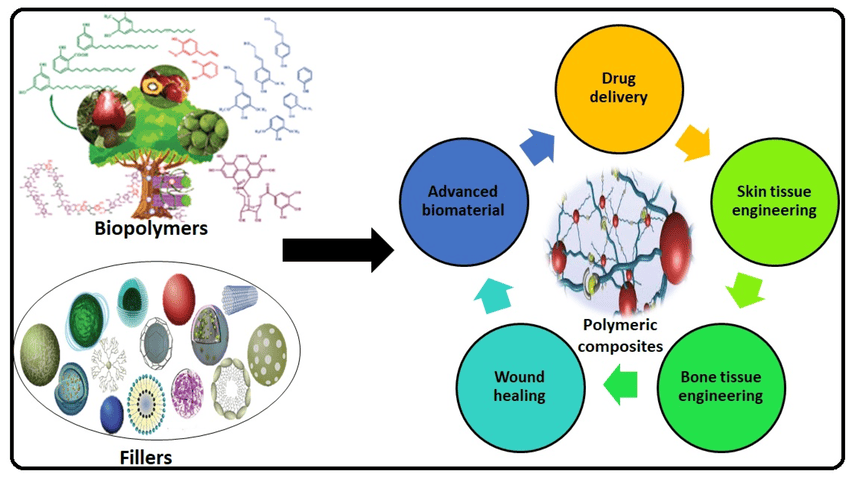
Advances in Sustainable Biopolymer-Based Composites: Feedstocks, Functionalities, Processing Technologies and Future Outlook
Title
Advances in Sustainable Biopolymer-Based Composites: Feedstocks, Functionalities, Processing Technologies and Future Outlook
Author
1. Myint Zu,
Student, Yangon University, Myanmar
2. Su Nandar,
Professor, Yangon University, India
Abstract
Sustainable biopolymer-based composites have emerged as essential alternatives to conventional petroleum-derived polymers due to the urgent need to reduce environmental pollution and promote renewable material cycles. Their development is closely associated with global sustainability goals, circular-economy frameworks, and green manufacturing practices. Biopolymers derived from natural, renewable resources such as plant fibers, microbial fermentation, and agro-industrial residues have demonstrated remarkable potential for high-performance material applications. These composites offer advantages including biodegradability, lightweight characteristics, improved mechanical behavior, and reduced carbon footprint. The rapid evolution of advanced processing techniques—such as reactive extrusion, melt blending, and additive manufacturing—has enabled the fabrication of customized biocomposite structures with enhanced functionality. Recent developments also show the integration of biopolymers into emerging fields, including energy storage, biomedical engineering, flexible electronics, and environmental remediation. Despite their progress, challenges remain regarding material stability, moisture sensitivity, cost competitiveness, and end-of-life management. This review synthesizes current advancements in feedstocks, material design, structural characteristics, applications, and processing strategies. It also outlines the technological opportunities and future research directions necessary to transform biopolymer composites into mainstream sustainable engineering materials.
Keywords
Conclusion
The field of sustainable biopolymer-based composites has evolved rapidly, driven by the global demand for environmentally conscious materials and the necessity to reduce dependence on fossil-fuel-derived plastics. These materials offer a unique combination of biodegradability, renewability, and tunable performance, making them attractive for numerous high-value applications. Developments in natural and microbial feedstocks, reinforced composite structures, and functional biopolymers have significantly improved the versatility and mechanical viability of these materials. Simultaneously, innovations in processing technologies—ranging from melt extrusion to additive manufacturing—have enabled the creation of complex and high-performance composites tailored for specific engineering needs.
The expanding use of biopolymer composites across sectors such as automotive, packaging, energy storage, biomedical engineering, and sustainable construction highlights their growing industrial relevance. Their ability to deliver mechanical strength, thermal stability, and eco-friendly characteristics positions them as essential elements of future material systems. However, challenges such as variability in natural fibers, limited long-term durability, and cost-related barriers must still be addressed to unlock their full potential.
Future research directions point toward optimizing feedstocks, enhancing recyclability, improving functionalization, and integrating digital tools such as machine learning for predictive material design. As industries continue shifting toward sustainability, biopolymer composites will play a central role in shaping a greener, more resource-efficient future. These materials embody the principles of environmental responsibility, renewable engineering, and circular-economy innovation, making them indispensable in next-generation sustainable material technologies.
Author Contrubution
The author was solely responsible for the study's conception, data collection, analysis, interpretation, and manuscript preparation.
Funding
The authors did not receive financial support from any public, commercial, or non-profit funding agencies for this research.
Conflict of Interest
All authors state that there are no conflicts of interest.
Data Sharing Statement
Not applicable.
Software And Tools Use
Not applicable.
Acknowledgements
I am thankful for the help and expertise of all contributors to this study and manuscript, as well as the insightful feedback from anonymous reviewers.
Corresponding Author
Copyright
Copyright: ©2026 Corresponding Author. This is an open access article distributed under the terms of the Creative Commons Attribution License , which permits unrestricted use, distribution, and reproduction in any medium, provided the original author and source are credited.
Zu, Myint, and Nandar, Su. “Advances in Sustainable Biopolymer-Based Composites: Feedstocks, Functionalities, Processing Technologies and Future Outlook.” Scientific Research Journal of Science, Engineering and Technology, vol. 3, no. 2, 2026, pp. 21-26, https://isrdo.org/journal/SRJSET/currentissue/advances-in-sustainable-biopolymer-based-composites-feedstocks-functionalities-processing-technologies-and-future-outlook
Zu, M., & Nandar, S. (2026). Advances in Sustainable Biopolymer-Based Composites: Feedstocks, Functionalities, Processing Technologies and Future Outlook. Scientific Research Journal of Science, Engineering and Technology, 3(2), 21-26. https://isrdo.org/journal/SRJSET/currentissue/advances-in-sustainable-biopolymer-based-composites-feedstocks-functionalities-processing-technologies-and-future-outlook
Zu Myint and Nandar Su, Advances in Sustainable Biopolymer-Based Composites: Feedstocks, Functionalities, Processing Technologies and Future Outlook, Scientific Research Journal of Science, Engineering and Technology 3, no. 2(2026): 21-26, https://isrdo.org/journal/SRJSET/currentissue/advances-in-sustainable-biopolymer-based-composites-feedstocks-functionalities-processing-technologies-and-future-outlook
2276
Total words972
Unique Words111
Sentence19.612612612613
Avg Sentence Length0.25397683397683
Subjectivity0.067012012012012
PolarityText Statistics
Viewed / Downloads
Total article views: 174 (including HTML, PDF, and XML)| HTML | XML | Total | |
|---|---|---|---|
| 108 | 31 | 35 | 174 |
Viewed (geographical distribution)
Thereof 174 with geography defined and 0 with unknown origin.