Lightweight ceramics, aramid fibers, and advanced polymer composites often dominate headlines in modern defense engineering. Yet when a high-velocity projectile strikes an armored hull or protective barrier, high-hardness armor steels remain at the core of real-world ballistic design. Among these materials, Ramor protection steels—especially grades 400, 500, and 550—show how classic metallurgical engineering stays indispensable even as composite technologies advance.
How Hardness Fights Penetration
Stopping a projectile requires absorbing and deflecting immense kinetic energy in a fraction of a millisecond. When a round hits a hard steel target, high surface hardness resists indentation, blunts or fractures the projectile tip, and spreads impact forces across a wider zone.
Ramor grades 400, 500, and 550 (named around their nominal Brinell hardness levels) give engineers a clear stepping scale of penetration resistance:
Ramor 400 balances strong projectile resistance with relatively high toughness and formability for general structural and vehicle protection.
Ramor 500 raises hardness to defeat tougher threats while keeping enough structural resilience for demanding defense platforms.
Ramor 550 pushes hardness higher still for severe ballistic threats where maximum resistance to tip deformation and penetration is critical.
The Strength–Toughness Trade-Off
In metallurgy, raising hardness almost always comes with a catch. As hardness climbs, and tend to drop. If a plate becomes overly hard and brittle, a single ballistic impact or blast wave can trigger shattering or rather than controlled energy absorption.
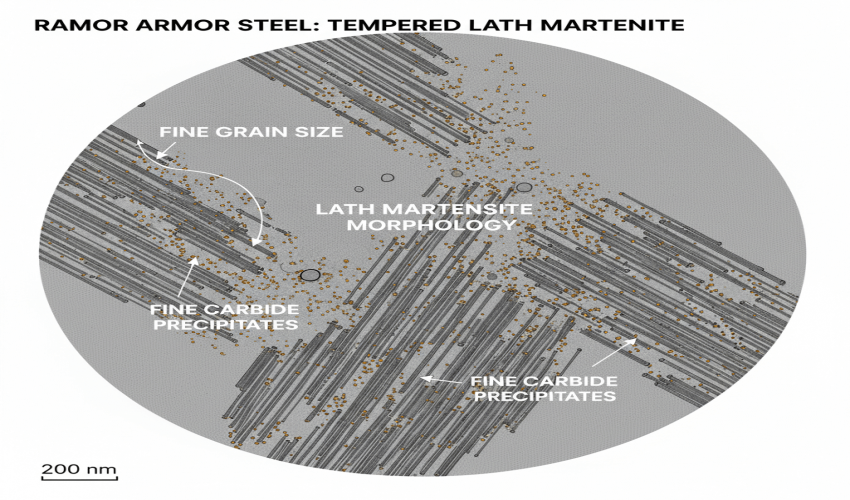
Controlled quenching and tempering allow Ramor steels to form a tempered martensitic structure. Rapid cooling creates hard martensite, while subsequent tempering relieves excess internal stresses and refines toughness. That microstructure lets the steel resist penetration without turning brittle under high-strain-rate loading.
Why Fabrication and Predictability Keep Steel Relevant
Composites offer attractive weight savings in specific roles, but they can suffer from , environmental sensitivity, or complex repair requirements in the field. Steel behaves predictably across multi-hit scenarios, temperature swings, and structural loads.
Predictable mechanical response: Engineers can model deformation, perforation thresholds, and structural load paths with high confidence.
Fabrication and repairability: Cutting, bending, welding, and field repairs are well understood when proper and heat-input procedures are followed.
Multi-purpose structural value: Armor plates often double as load-bearing parts of vehicles, shelters, and protective enclosures.
Practical Takeaway for Metallurgical and Defense Engineers
Choosing armor is never about chasing a single property in isolation. Ramor 400, 500, and 550 succeed because they pair controlled heat treatment and tempered martensite with dependable manufacturability—keeping high-hardness steel essential alongside modern composites in ballistic protection systems.
Leave a Reply
Your email address will not be published. Required fields are marked *