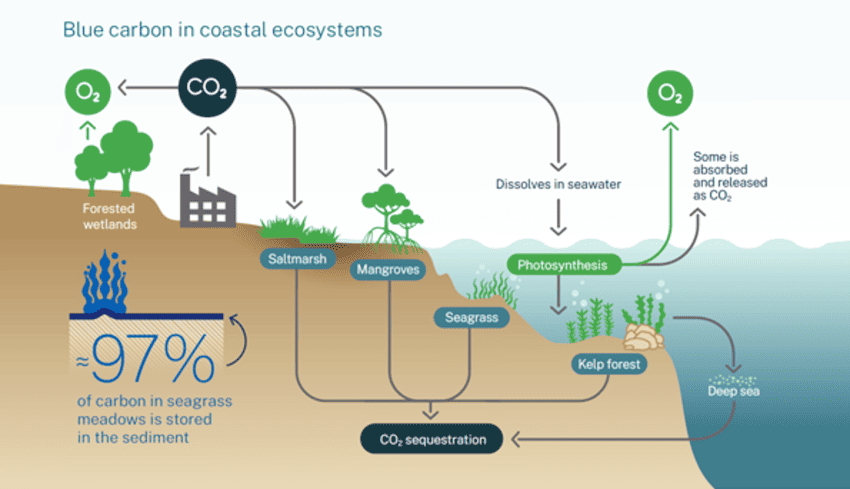
Blue Carbon Dynamics in Coastal Ecosystems: Mechanisms of Mangrove Carbon Sequestration, Climate Change Interactions, and Conservation Pathways
Title
Blue Carbon Dynamics in Coastal Ecosystems: Mechanisms of Mangrove Carbon Sequestration, Climate Change Interactions, and Conservation Pathways
Author
1. Gulbin Sultana,
Student, Maldives National University (MNU), Maldives, Maldives
2. Mariyam Shameem,
Professor, Maldives National University (MNU), Maldives, Maldives
Abstract
Coastal ecosystems play a significant role in global climate regulation by capturing and storing atmospheric carbon dioxide. Among these systems, mangroves, salt marshes, and tidal wetlands collectively contribute to what is known as blue carbon. These ecosystems are highly efficient carbon sinks because they store large quantities of organic carbon in their biomass and sediment layers for long periods. Mangrove forests, in particular, are recognized for their high productivity and capacity to trap sediments, which enhances long-term carbon storage. In recent decades, scientific attention toward blue carbon ecosystems has increased due to their potential to mitigate climate change and provide ecosystem services such as shoreline stabilization, biodiversity conservation, and fisheries support. However, coastal development, pollution, and climate-related disturbances threaten the stability of these ecosystems. Understanding the mechanisms that regulate carbon sequestration, sediment accretion, and nutrient cycling in coastal wetlands is therefore essential for designing effective conservation strategies. This review explores the ecological and biogeochemical processes that control carbon accumulation in mangrove ecosystems and other tidal wetlands. It also discusses the influence of climate change, anthropogenic pressures, and policy frameworks aimed at protecting blue carbon reservoirs. The review highlights current scientific knowledge, identifies research gaps, and outlines future directions for sustainable management of coastal carbon sinks.
Keywords
Conclusion
Blue carbon ecosystems, particularly mangrove forests and tidal wetlands, represent some of the most efficient natural carbon sinks on Earth. Their ability to capture and store atmospheric carbon within biomass and sediments makes them vital components of global climate regulation. These ecosystems also provide numerous ecological and socio-economic benefits, including biodiversity conservation, fisheries support, and coastal protection. However, increasing environmental pressures and human activities threaten the stability of these valuable habitats. Strengthening conservation policies, implementing restoration initiatives, and promoting sustainable coastal management are essential for maintaining the long-term functionality of blue carbon ecosystems. Continued scientific research and international collaboration will play a crucial role in enhancing our understanding of coastal carbon dynamics and ensuring the preservation of these ecosystems for future generations.
Author Contrubution
The author handled all aspects of the study, including its design, data collection, analysis, and manuscript preparation.
Funding
No specific financial support from public, commercial, or non-profit funding agencies was received for this research.
Conflict of Interest
There are no conflicts of interest to report from any of the authors.
Data Sharing Statement
Not applicable.
Software And Tools Use
Not applicable.
Acknowledgements
I am grateful for the expertise and help provided by all who contributed to this study and manuscript, and for the comments from anonymous reviewers.
Corresponding Author
Gulbin Sultana
Maldives National University (MNU), Maldives, Student, Maldives
Mariyam Shameem
Maldives National University (MNU), Maldives, Professor, Maldives
Copyright
Copyright: ©2026 Corresponding Author. This is an open access article distributed under the terms of the Creative Commons Attribution License , which permits unrestricted use, distribution, and reproduction in any medium, provided the original author and source are credited.
Sultana, Gulbin, and Shameem, Mariyam. “Blue Carbon Dynamics in Coastal Ecosystems: Mechanisms of Mangrove Carbon Sequestration, Climate Change Interactions, and Conservation Pathways.” Scientific Research Journal of Environment, Earth and Physical Science, vol. 3, no. 2, 2026, pp. 43-49, https://isrdo.org/journal/SRJEEP/currentissue/blue-carbon-dynamics-in-coastal-ecosystems-mechanisms-of-mangrove-carbon-sequestration-climate-change-interactions-and-conservation-pathways
Sultana, G., & Shameem, M. (2026). Blue Carbon Dynamics in Coastal Ecosystems: Mechanisms of Mangrove Carbon Sequestration, Climate Change Interactions, and Conservation Pathways. Scientific Research Journal of Environment, Earth and Physical Science, 3(2), 43-49. https://isrdo.org/journal/SRJEEP/currentissue/blue-carbon-dynamics-in-coastal-ecosystems-mechanisms-of-mangrove-carbon-sequestration-climate-change-interactions-and-conservation-pathways
Sultana Gulbin and Shameem Mariyam, Blue Carbon Dynamics in Coastal Ecosystems: Mechanisms of Mangrove Carbon Sequestration, Climate Change Interactions, and Conservation Pathways, Scientific Research Journal of Environment, Earth and Physical Science 3, no. 2(2026): 43-49, https://isrdo.org/journal/SRJEEP/currentissue/blue-carbon-dynamics-in-coastal-ecosystems-mechanisms-of-mangrove-carbon-sequestration-climate-change-interactions-and-conservation-pathways
2926
Total words979
Unique Words149
Sentence19.201342281879
Avg Sentence Length0.22489493448386
Subjectivity0.051293144774688
PolarityText Statistics
Viewed / Downloads
Total article views: 147 (including HTML, PDF, and XML)| HTML | XML | Total | |
|---|---|---|---|
| 95 | 28 | 24 | 147 |
Viewed (geographical distribution)
Thereof 147 with geography defined and 0 with unknown origin.