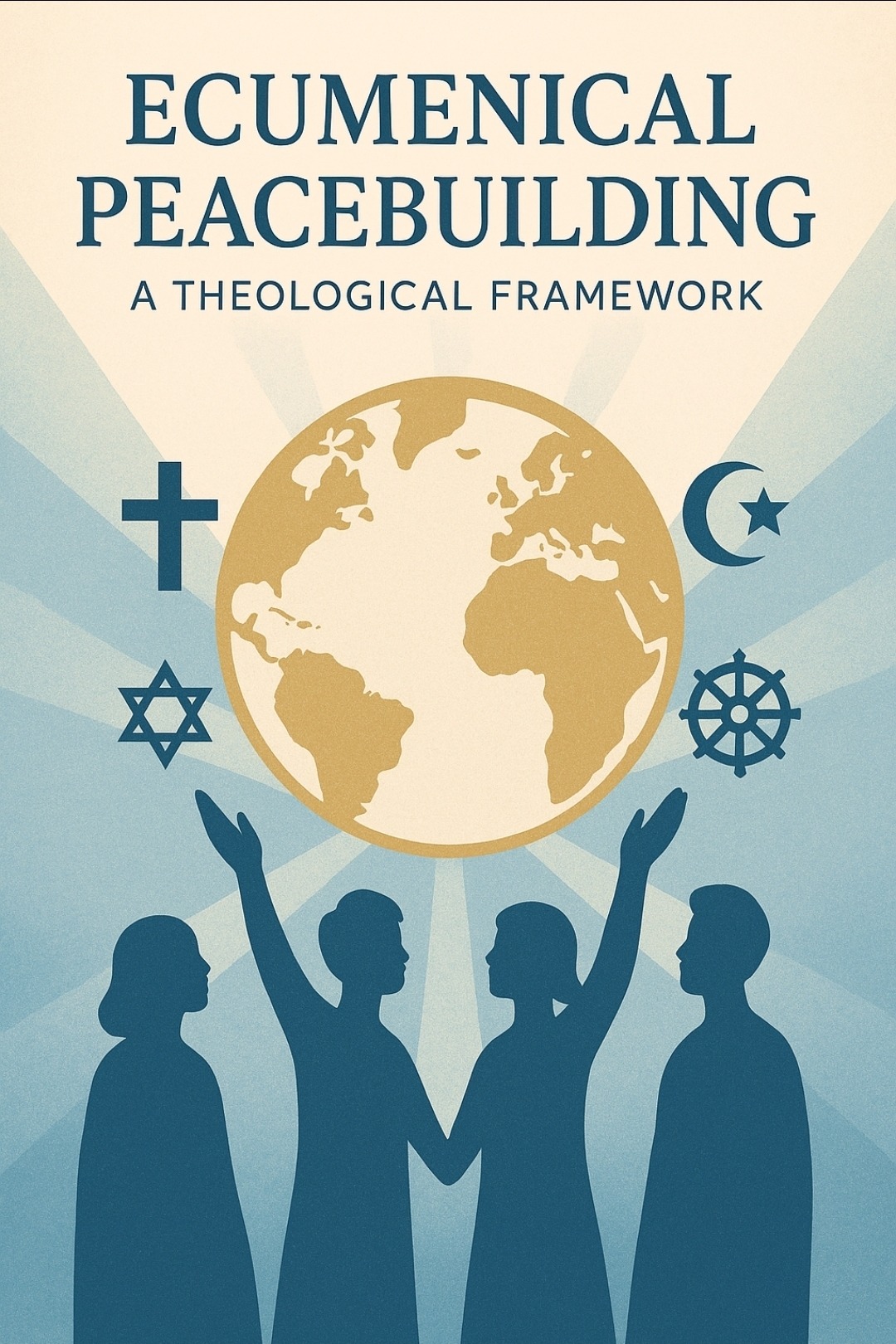
From Chaos to Communion: Ecumenical Peacebuilding Amid Conflict
Title
From Chaos to Communion: Ecumenical Peacebuilding Amid Conflict
Author
1. Mohammad HekmatAfshar, Student, Göteborgs Universitet, Sweden
Abstract
This essay, by focusing on contemporary events and outstanding initiatives, observes how Christian ecumenism, advocating for peace since 1925, has addressed conflict. The transitional evolution of the Church from denominations to a unique organization committed to social reform is explored, beginning its mission prior to World War II and culminating its initiatives at the 1925 Stockholm Conference. It commemorates the redemptive potential of youth involvement, interfaith conversation, and ecumenical diakonia in service to the speeding global injustices - racial trauma, displacement, climate change, etc. Grounded on faith, love, and symbolic literacy, the paper progresses models of spiritual anthropology and economic freedom. By viewing interreligious quarrels through theological and practical understanding, Ecumenism transcends contextual conflict and guides a shift toward justice and harmony, as envisioned by Jesus Christ. This peacebuilding approach, originating from divine compassion, offers a cooperative and all encompassing path to unity and reconciliation, though it remains far from a panacea for human suffering.
Keywords
Conclusion
Scholarly sources suggest that peace and justice are grounded in literature. Diakonia, understood as service to humanity guided by morality, faith and rights, is central to the church's purpose, particularly when addressing issues like poverty, migration and climate change (ACT–AWCC, 2022, p. 68). Along the reconciliation journey, the concept belongs to a Pilgrimage of Justice and Peace, which is an effort to address racial injustice, trauma and truth through solidarity and community (Enns, 2022, p. 272). It can heal sites of conflict in the long term through sensitive interreligious dialogue based on profound theological and symbolic knowledge. Rather than relying only on institutions, transformative ecumenism rethinks traditional teachings, metaphors, and how people see their community, which can foster peace through meaning instead of just procedures.
According to the WCC-ACT definition, the joint ecumenical work of the ACT Alliance and World Council of Churches on ecumenical diakonia, shows that the ecumenical movement has strongly resonated with regional issues. It has started institutional relationships, applied social and political pressure, and made diaconal work more professional, showing strategic realism in its actions (ACT–AWCC, 2022, p. 10).
Theologically, there are internal disagreements and different views on the Kingdom of God (UCCLW, 1926, p. 453). Some view it, the same source stating, as a new order ruled by God in social context, while others view it as a matter of belief for salvation or pardon. Therefore, it doesn't matter if we consider Kingdom of God as individual or communal, material or spiritual (UCCLW, 1926, pp. 453–454). Churches may be less politically influential because Christians tend to be in the minority in a nation (UCCLW, 1926, p. 451). Hence, there have to be calls to action rather than just rhetoric (UCCLW, 1926, p. 502).
Peace efforts must be locally specific and well rooted in areas of conflict in order to function. To hold a real progress, it's crucial for Christian organizations, secular groups and individuals of all religions, to collaborate while embracing their mutual goal of creating a sustainable and just society (ACT–AWCC, 2022, p. 112). Continued investment in developing diaconal skills and training practitioners with both theological insight and technical skills, is needed to handle complex global problems (ACT–AWCC, 2022, p. 113). By restating diakonia as a prophetic call for justice, focusing on economic, climate, gender, racial and health equality, the ecumenical movement can empower and heal. It can inspire a new generation of diakonia to actively change social structures (ACT–AWCC, 2022, p. 105). Through an inclusive vision that combines spiritual belief with practical action, the Church can fulfill its role in building peace.
Author Contrubution
The author solely conceived, researched, and wrote the entire manuscript.
Funding
No external funding was received for the completion of this study.
Conflict of Interest
The author declares no conflict of interest.
Data Sharing Statement
No datasets were generated or analyzed for this study, and no additional data are available.
Software And Tools Use
Acknowledgements
The author extends sincere gratitude to EHS.se and to all teachers and guest lecturers who contributed to the ecumenism course marking the 100th anniversary, 2025, of the ecumenical movement. Special thanks are offered to: Sara Gehlin, senior lecturer at University College Stockholm and course coordinator; Vera la Mela, part‑time lecturer at University College Stockholm and doctoral student at Lund University; Ulf Bergsviker, part‑time lecturer at University College Stockholm and doctoral student at Uppsala University; Stephen Brown, researcher and editor of the Ecumenical Review at the World Council of Churches Publications; Almut Bretschneider‑Felzmann, doctoral student and theological advisor/ecumenical officer at the Church of Sweden National Offices; Alexander Heindel, Erasmus+ researcher at University College Stockholm and doctoral student/lecturer at the University of Münster; Jonas Ideström, professor and prefect at University College Stockholm; Petter Jakobsson, senior advisor for Mission Theology, Religion and Development at the Swedish Mission Council; Fr. Miltuin Janjic, senior lecturer at St Ignatios College/University College Stockholm; Michael Nausner, professor and researcher at the Church of Sweden Research Department and affiliated researcher at University College Stockholm; Benjamin Simon, professor and dean at the Bossey Ecumenical Institute. Their teaching, insight and ecumenical commitment greatly enriched the learning experience that informed this work.
Corresponding Author

Mohammad HekmatAfshar
Göteborgs Universitet, Student, Sweden
Copyright
Copyright: ©2026 Corresponding Author. This is an open access article distributed under the terms of the Creative Commons Attribution License , which permits unrestricted use, distribution, and reproduction in any medium, provided the original author and source are credited.
HekmatAfshar, Mohammad. “From Chaos to Communion: Ecumenical Peacebuilding Amid Conflict.” Scientific Research Journal of Arts, Humanities and Social Science, vol. 3, no. 2, 2026, pp. 60-71, https://isrdo.org/journal/SRJAHS/currentissue/from-chaos-to-communion-ecumenical-peacebuilding-amid-conflict
HekmatAfshar, M. (2026). From Chaos to Communion: Ecumenical Peacebuilding Amid Conflict. Scientific Research Journal of Arts, Humanities and Social Science, 3(2), 60-71. https://isrdo.org/journal/SRJAHS/currentissue/from-chaos-to-communion-ecumenical-peacebuilding-amid-conflict
HekmatAfshar Mohammad, From Chaos to Communion: Ecumenical Peacebuilding Amid Conflict, Scientific Research Journal of Arts, Humanities and Social Science 3, no. 2(2026): 60-71, https://isrdo.org/journal/SRJAHS/currentissue/from-chaos-to-communion-ecumenical-peacebuilding-amid-conflict
5891
Total words2107
Unique Words252
Sentence21.869047619048
Avg Sentence Length0.20735362410958
Subjectivity0.036445148766577
PolarityText Statistics
Viewed / Downloads
Total article views: 174 (including HTML, PDF, and XML)| HTML | XML | Total | |
|---|---|---|---|
| 102 | 43 | 29 | 174 |
Viewed (geographical distribution)
Thereof 174 with geography defined and 0 with unknown origin.